


Author: Kriszitna Nagy
“I’ve been living in one of the world’s most heavily sanctioned countries for two years now, and what can I say? Everything is still available here. Supermarkets often have a wider selection than in Europe. The shelves are full, and prices are frequently lower. Services remain excellent, and global brands are still present. (…) Life is buzzing: restaurants, exhibitions, fashionable parties. Everything is just as vibrant as anywhere else – if not more so.”
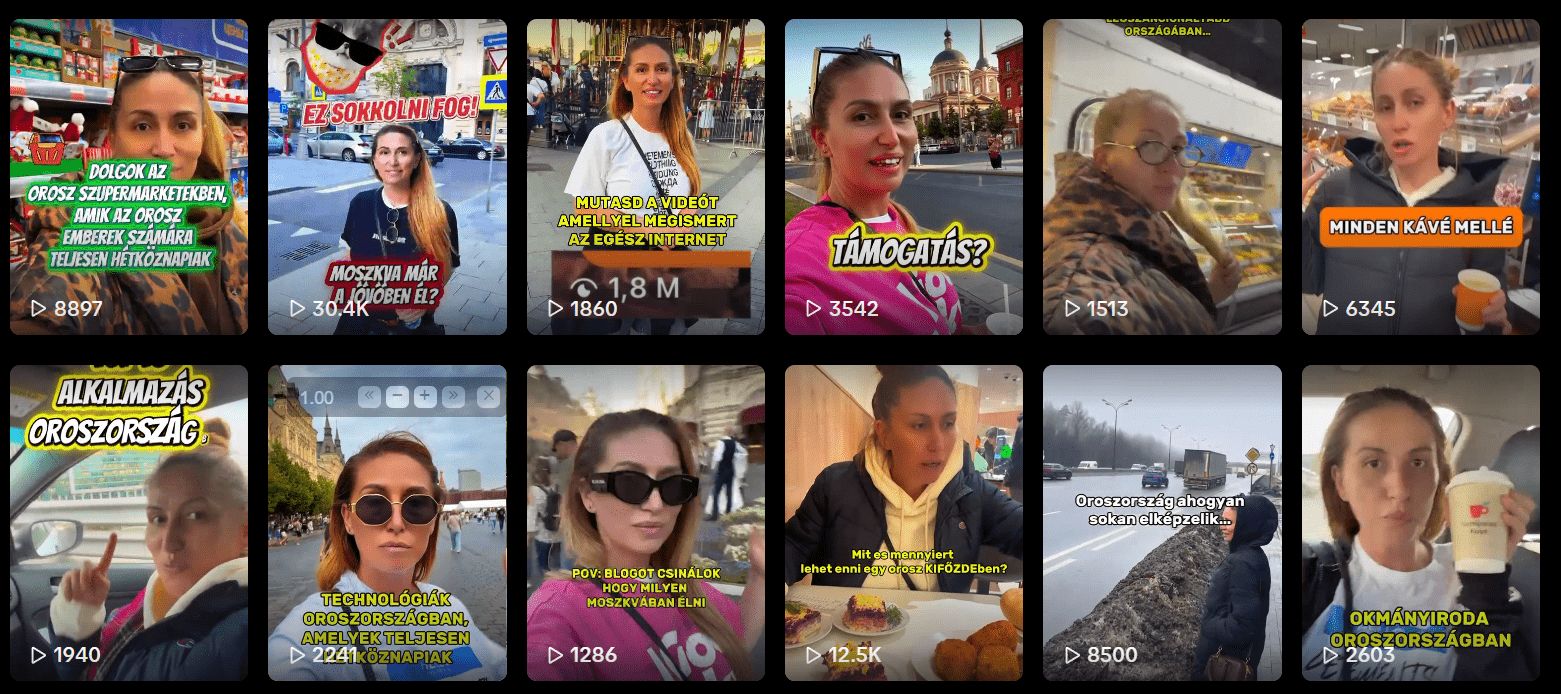
So claims a TikTok user posting as @nagyvarosielet in a video that has racked up 219,000 views. The creator, a woman who speaks Hungarian at a native level but with a slight Russian accent, says she moved to Russia in December 2022. Her TikTok bio reads: “Let’s discover Russia together.” In her videos she showcases, in Hungarian, various products, services and curiosities about the country – or at least, that is how it appears.
Visually, the clips are varied; in content, they are strikingly one-sided. What emerges is an idyllic image of Russia as safe, affordable, technologically advanced and full of vibrant urban life – a country offering generous family benefits and apparently untouched by sanctions or by the war currently under way. This portrayal closely mirrors Kremlin disinformation narratives, which seek to present Russia in a favourable light, undermine the credibility of Western institutions and relativise responsibility for the war.
Failed sanctions?
One of the most common pro-Kremlin narratives circulating on social media concerns the supposed ineffectiveness of sanctions, says Dorka Takácsy, an expert on Russia: “Content creators typically try to ‘prove’ that the sanctions aren’t working, often pointing – using false reasoning – to sectors that the sanctions don’t even target.”
This line of argument is prominent in @nagyvarosielet’s TikTok videos. The creator appears simply to be showing that Russian supermarkets offer “a much wider selection than anywhere else”, demonstrating the array of meat products, caviar, butter, soft drinks and other goods, and pointing out that global brands haven’t vanished, luxury cars still cruise the streets and tourism in Moscow is booming. Yet these seemingly innocuous videos are consistently framed around sanctions: most are produced in response to questions or claims about their effects.
“Is it true that butter has become very expensive in Russia, that supplies are running low and that shops now keep butter locked away in plastic boxes? I’ve seen this claim in several places – come with me and let’s check! […] Once in the supermarket, I didn’t see any shortages at all – in fact, the selection is still quite large.”
Such videos can give the impression that sanctions have failed – that Western pressure is not being felt in Russia, that fears around their impact are baseless and that Russian stability is unshaken. But this conclusion is misleading: sanctions are not primarily aimed at consumer goods, but at the financial sector, export chains and the military-industrial complex. Their effectiveness cannot be judged by whether there is meat or butter on supermarket shelves. And the videos lean heavily on Moscow as a stand-in for the entire country, glossing over the far harsher realities of Russia’s regions.
For more content follow EUROFOCUS on social media:
Facebook /eurofocus.media
Instagram /eurofocus.ef
TikTok /eurofocus.media
Substack /@eurofocus
Decadent West vs safe, family-friendly Russia
In several vlogs, @nagyvarosielet portrays Russia as peaceful and safe. One video uses a misleading comparison: according to her, the most common Google search in European, American and Asian countries is “Will there be a Third World War?”, whereas in Russia it is “Where can I go on a cheap holiday?”. The implication is that Western citizens live in constant fear of war, while Russians – despite their country being at war for almost four years – are busy planning summer getaways.
The Kremlin’s communication strategy also frequently invokes the defence of “traditional values”, especially the centrality of the family. This narrative features prominently on the creator’s channel, where she highlights state benefits for mothers and children, food packages, discounts and other forms of support, all presented as exemplary care for families.
What is absent is the reality that this “family-friendly” Russia is sending its young people to war in large numbers. More than 149,000 Russian military deaths have been confirmed – over 12,000 of them under the age of 24 – and the true death toll is believed to be far higher. Including the wounded, the war may already have produced around one million casualties. Recruitment has surged, and military service can be financially attractive, especially in poorer regions with low wages and high unemployment. The state also pays substantial compensation to families of fallen soldiers – sometimes worth decades of income – creating a powerful incentive in certain areas.
In another video, the creator claims that many Western individuals and families – American, French and others – have moved to Russia because it is “safer” and because “family is the highest value” there. The image is of a peaceful, value-driven society that is increasingly appealing to Westerners. One of the Kremlin’s most frequently repeated narratives contrasts a morally decadent, declining West that has abandoned traditional values with a Russia that upholds and protects them.
According to Takácsy, such content often exaggerates Western problems while implying that nothing comparable exists in Russia:
“The aim is usually to weaken the West – and specifically to undermine support for Ukraine.”
The Kremlin assumes that public opinion matters greatly in democratic societies, she notes. Its strategy is therefore to erode public support: divide or unsettle Western audiences, thereby putting indirect pressure on political leaders. The overarching goal is to foster sympathy for Russia in Western societies and, in parallel, reduce political and military support for Ukraine. Disinformation is a particularly effective tool – cheap, far-reaching and, thanks to countless proxy accounts, hard to trace.
What is the real Russia?
A recurring theme in the videos is Moscow’s technological sophistication: self-driving trams, service robots, smart scales, capsule hotels, “pay with a smile” systems and so on. The aim is clear – to reframe Russia as modern, user-friendly and forward-looking, capable of competing with Western innovation.
Similar is the intent behind the “Is this still how you imagine Russia? vs the real Russia” videos. These contrast Western stereotypes – grey tower blocks and bleak landscapes – with colourful, lively streets, high-tech solutions and gleaming infrastructure.
But this narrative glosses over the enormous disparities between Moscow and the rest of the country. While self-driving trams glide between skyscrapers in the capital, many poorer regions lack even basic infrastructure. Economic and social inequalities between Russia’s regions and its two major cities – Moscow and St Petersburg – are vast. Poverty remains widespread in the countryside, and in some areas, the share of people living below the subsistence level is strikingly high. Yet the videos repeatedly imply that the capital’s development reflects the country as a whole. Likewise, the “real Russia” presented through cosy Christmas markets, colourful onion domes and snow-dusted Moscow squares bears little resemblance to the wider reality.
Some TikTok users have noticed this one-sidedness. Under one “expectation vs reality” video, a commenter asked: “What do you think of the slums outside the Moscow Ring Road?” The creator replied: “Give me an address so I can see it. I’ve been living in Moscow for two years and I’m still looking. I assume you’ve been here longer and managed to find it.” Another user wrote: “Even by their own statistics, 22% of Russian households still don’t have running water!!! Moscow and St Petersburg are nice – like downtown Pyongyang.” Again, the creator dismissed it: “No way?! I haven’t seen anything like that here. You’ve been there? Got your own video? Show me.”
This refusal to acknowledge wider realities underscores the point: the creator offers not a balanced account, but a uniformly positive portrayal of Russia.
New username, same content
Although the @nagyvarosielet account only began posting videos in December 2024, many users already knew the creator from her previous account, @impress_il_mio_mondo, active since 2023 and featuring similar content for the same audience. That account was even cited by Hungarian pro-government media in their attacks on sanctions.
As comments revealed, the earlier account was deleted, prompting the creation of @nagyvarosielet. The creator is also active on Instagram, posting as @sziaprivet, where she has close to 30,000 followers.
Kremlin narratives hidden in lifestyle content
Across the world, it is increasingly common for Kremlin narratives to appear covertly on social media, in multiple languages, embedded in the videos of lifestyle and travel influencers who seem, at first glance, entirely apolitical. Like @nagyvarosielet, several high-reach non-Russian vloggers and influencers have been spreading strikingly similar messages across various platforms.
Because these creators speak in the audience’s native language, they appear more trustworthy and authentic. The seemingly apolitical nature of lifestyle content makes this form of communication especially effective. Russian technological “wonders”, flashy cityscapes or unfamiliar products tap into the curiosity of foreign viewers: unsuspecting audiences may feel they are simply consuming entertainment. Although influencers are only one component of the Kremlin’s multifaceted propaganda ecosystem, they nonetheless have the ability to reach vast audiences: on social media platforms they can shape public opinion and influence how Russia is perceived around the world.

