


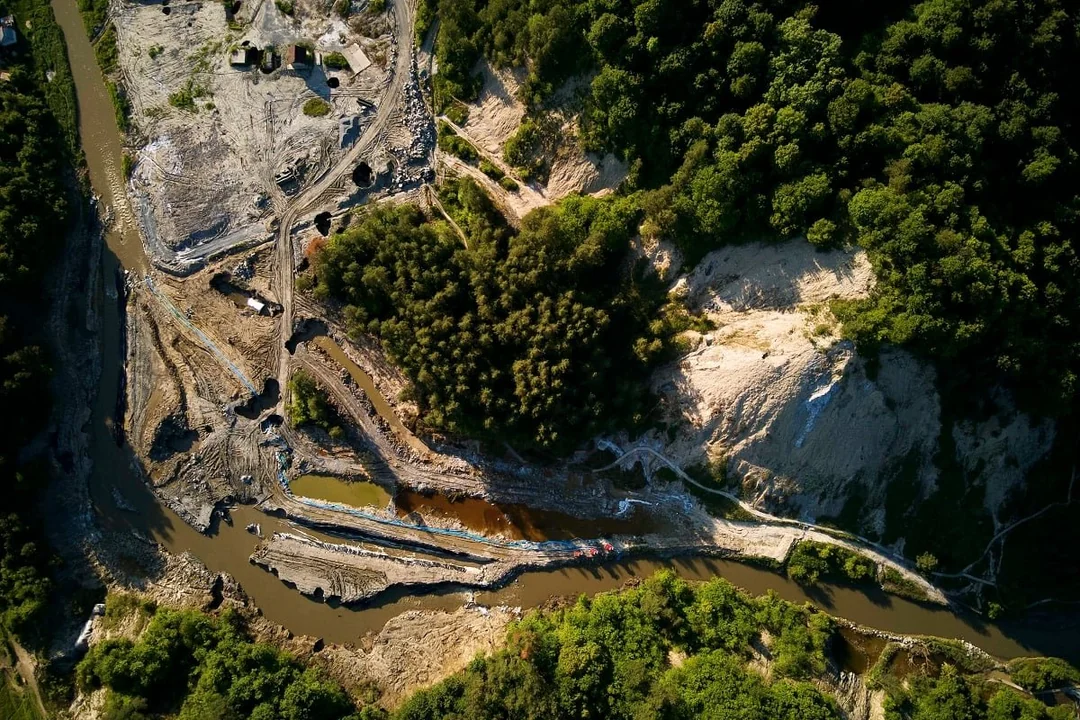
The Parajd salt mine was closed on 5 May 2025 after water from the swollen Korond stream began seeping in. Despite emergency interventions, the heavy floods that followed between 27 and 29 May completely submerged the mine.
As often happens in the wake of natural disasters, unexpected losses or unexplained events, conspiracy theories quickly flooded social media and certain news sites. Within hours, wild claims began circulating online.
Some alleged that the disaster was deliberate – part of a plan to transfer Romania’s salt production into Hungarian or Austrian hands. Others invoked Russian plots, divine intervention, NATO interests, or even blamed beavers for the collapse. Despite their sensational headlines and complete lack of evidence, these theories have gained significant traction.
“A Hungarian NGO prevented the diversion of the Korond stream, and that’s why the salt mine was destroyed”
Dan Diaconescu, the television personality notorious for his sensational style, quickly joined the chorus. In a video posted to Facebook, he claimed to possess “proof of a plot against the Parajd salt mine, once the pride of Romania.” Diaconescu alleged that the first step in this so-called “serial killing” of the mine occurred in 2011, when the Romanian state appointed a Hungarian NGO, the Cholnoky Jenő Geographic Society, to supervise the Parajd mine, thereby weakening Romanian state control.
He then presented a document which, he claimed, showed that the NGO halted in 2013 a Salrom investment project – by Romania’s largest state-owned salt producer – designed to defend the mine against infiltration and to divert the Korond stream.
The document in question, however, was part of an environmental permit application, in which the NGO merely warned of the potential impact on a protected area. The Hungarian organisation had indeed been granted custodianship in 2011 of the Sószoros Nature Reserve within the Korond–Parajd Conservation Authority, and in that role opposed the diversion of the stream. But the paperwork does not support Diaconescu’s claim of responsibility.
The organisation’s president, Zoltán Imecs, denied any involvement. He told Krónika newspaper that their role was purely consultative:
“The custodianship has no legal power to make decisions – only to offer opinions. The decision rests with higher authorities, the environmental agency and the ministry. By law, any activity planned in a protected area – construction, development or otherwise – requires the opinion of the official custodian. That’s what happened in the case of the proposed dam on the Korond stream,” Imecs said.
Diaconescu also claimed the NGO was based in Cluj-Napoca but run from Budapest. In fact, it is registered in Cluj, and there is no indication of Hungarian control. Imecs himself is a lecturer at Babeș-Bolyai University’s Faculty of Geography in Cluj.
The Austro-Hungarian Empire and a ruined salt mine?
The website realitate.ro published an article titled “The stakes of Parajd’s destruction: who wants Romania’s resources?” Its opening line declared: “The flooding of the Parajd salt mine has revived accusations that Austria and Hungary are seeking to seize Romania’s natural resources,” thus framing the conspiracy’s central narrative.
For those wondering why Hungary would want a flooded, unusable salt mine, other outlets rushed to provide an answer:
“The Hungarians deliberately destroyed the salt mine so they could build a new one.”
An article on rgnpress.ro went further, linking the Cholnoky Jenő Geographic Society to a Hungarian business that recently won extraction rights for another salt mine in Cluj County. Its headline read: “After a Hungarian NGO destroyed the Parajd salt mine, Hungary seizes the opportunity to open a new one in Romania.”
The piece claimed that a Hungarian family company, Salt-Veres Zrt., plans to open one of Europe’s most advanced salt mines in Valea Florilor (Virágosvölgy) after obtaining extraction rights last year – insinuating a connection between this and the Parajd disaster.
Several other publications picked up the theme, suggesting that Hungarians deliberately ruined Parajd as part of a long-term strategic plan to benefit the new, Hungarian-run mine. The theory appeared in Gazeta de Cluj, and was echoed by evz.ro in an article titled “Hungary’s strategic move in Romania’s heart: a plan for an invaluable treasure”, as well as stiripesurse.ro, which ran with “Hungary exploits Romania’s laziness: they bought a salt mine and turned it into Europe’s largest.”
The story of the Valea Florilor mine being acquired by a Hungarian firm is true. The company owner’s son, Márton Veres, told portfolio.hu in an interview that they plan to create one of Europe’s most modern salt mines. The claim of a plot with the Cholnoky Society to destroy Parajd, however, has no basis in fact.
“God flooded the mine to stop it becoming a NATO base”
Other outlandish theories also gained traction online. One of the most popular claimed that NATO had planned to turn the Parajd salt mine into a logistics base for a forthcoming war against Russia – but God intervened, flooding the mine to prevent it.
The post, by a Facebook user named Nadabaica Cătălin with 6,500 followers, appeared on 30 May. It read:
“Just so you know: The Parajd salt mine was to become a NATO logistics centre, closed to visitors, equipped with command offices and all necessary facilities for the upcoming war against Russia planned by NATO. No one talks about the fact that cable and network infrastructure was already being installed underground before the floods, and that the mine was already inundated by a vast underground water stream. They blamed a nearby surface river, but the flooding began days earlier and was covered up. God exists and does not sleep… He simply disagreed with this!”
The post was shared over 240 times. Comments included claims that a similar NATO base was being built under the Turda salt mine – explaining why it was closed for two weeks last summer – or that there is already a secret, heavily guarded NATO base in the Bucegi Mountains. One commenter wrote that convoys of trucks and containers were crossing into Moldova daily via the Siret border, “proving” NATO occupation. Others insisted this war and the base had been planned for 15 or even 35 years.
The post also appeared in a Facebook group supporting former presidential candidate Călin Georgescu, known for sharing conspiracy-laden content. Georgescu surprisingly won the first round of Romania’s 2024 presidential election, but the vote was later annulled over suspected Russian interference, and he was barred from running again in the May 2025 repeat election.
“The beavers are to blame”
A different explanation came from Bogdan Ivan, a minister from the ruling PSD party, who claimed beavers were responsible for the Parajd disaster. Ivan dismissed suggestions that Salrom – whose board chair, Nicolae Cîmpeanu, is also a PSD politician from Buzău – bore any responsibility.
Several environmental organisations working in the region have pointed out, however, that no beavers live in the area. Even if they did, Romanian law allows their relocation – making this claim, like many others surrounding the Parajd flood, another unlikely entry in a growing catalogue of implausible explanations.

Funded by the European Union. Views and opinions expressed are however those of the author(s) only and do not necessarily reflect those of the European Union or European Commission. Neither the European Union nor the granting authority can be held responsible for them.

