


Balázs Dávid, journalist
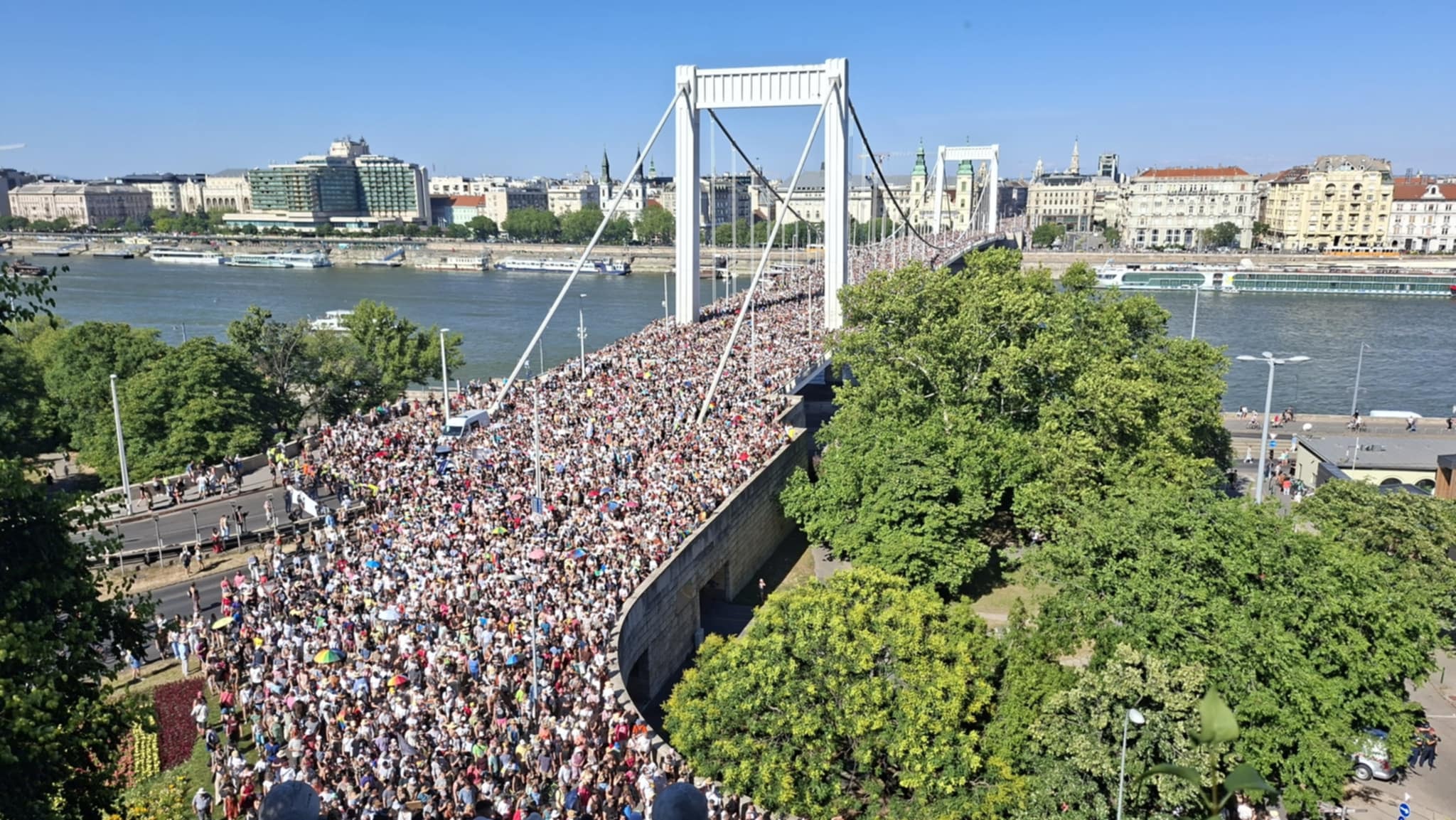
In defiance of a government ban and under the watchful eye of facial recognition cameras, tens of thousands of people marched through the heart of Budapest on Saturday in the 30th annual Pride parade—transforming what the government had sought to suppress into one of the largest political demonstrations in Hungary’s recent history. The march, officially banned under recently passed legislation restricting LGBTQ+ gatherings, unfolded peacefully despite official warnings, police surveillance, and political threats. Participants—among them European MPs, foreign diplomats, families with children, and first-time marchers—walked from the Municipality of Budapest to the Danube, waving rainbow flags and signs declaring solidarity, equality, and resistance.
What began as a celebration of LGBTQ+ identity quickly became a vivid act of protest against Prime Minister Viktor Orbán’s illiberal regime. With heat shimmering off the cobblestones and rainbow flags billowing in the air, demonstrators moved from the city’s historic centre to its riverside boulevards, chanting slogans not just for equality, but for democracy itself.
Organisers estimated a turnout of up to 200,000—a record number in a country where LGBTQ+ rights have been under increasing attack. The event marked a stunning rebuke of the government’s attempt to outlaw the march earlier this year, under legislation banning LGBTQ+ events nationwide and permitting facial recognition surveillance of participants.
A notable feature of this year’s Pride was the presence of thousands who had never attended before. One organiser dubbed them “Pridebutantes”—many of them young, politically awakened, and no longer willing to be silent.
A March Born of Resistance
The stakes were high even before the parade began. Earlier this year, the Hungarian government passed sweeping legislation that effectively banned Pride events, allowed facial recognition surveillance of participants, and labelled any appearance at the march as a legal violation. Justice Minister Bence Tuzson went as far as warning foreign embassies that attendance would constitute a punishable offence—even for diplomats.
Yet by Saturday, the ban had collapsed under the weight of international attention and local resolve. More than 70 members of the European Parliament were present, along with visitors from across the continent. Foreign diplomats were visibly present, although many attended unofficially or without public identification. Greta Thunberg was spotted among the crowd. This is a message to every far-right government in Europe,” said Moritz Körner, a German MEP. “Silencing Pride means silencing freedom—and we will not let that happen.” One Polish politician, marching in a European Union flag cape, summed it up: “If fear wins, the far-right wins.”
A Government Defied—and Exposed
Prime Minister Orbán had staked political capital on banning the event, declaring in February that it would not go ahead, citing “Brussels-imposed values” and “protection of children.” In a message to supporters on the day of the march, he painted the Pride as a foreign provocation, warning that without Fidesz, Hungary would face the same fate in areas like migration, war policy, and energy subsidies.
Though the government claimed the parade was being held on “Brussels’ orders,” opposition figures seized the moment to reframe the event not as a foreign imposition but as a democratic necessity. For Budapest mayor Gergely Karácsony, who backed the march and whose administration helped coordinate with police to ensure peaceful proceedings, it was a clear victory. “Today,” he told the crowd, “Budapest became the capital of Europe.”
Meanwhile, Péter Magyar—the rising political challenger from the centrist Tisza party—was notably absent, a move interpreted by some as political caution, and by others as a missed opportunity to signal support. Critics questioned the move, suggesting it risked alienating younger, progressive voters. The Tisza party later stated it refused to walk into “Orbán’s trap” designed to polarise society and distract from issues such as crumbling healthcare and soaring living costs.
Irony, Optimism, and a Hint of 1989
Despite heavy police presence, there were no major incidents. Officers, many visibly uncomfortable, ensured crowd safety even while their own government continued to label the gathering illegal, for which the participants thanked the authroities and showed their support to them. Organisers reported a “festival atmosphere”—less nudity than in Western parades, but more irony and sharp political commentary. “There was no hatred,” said one participant. “Just hope.”
A festive mood prevailed, even under the surveillance cameras installed along the route. In a nod to Hungary’s democratic awakening in 1989, many noted the symbolic weight of reclaiming the streets in peaceful protest. “It felt like history,” said David, 25, attending with his mother. “Like we were reminding the regime that it doesn’t own this city.”
The government-aligned media, however, painted a different picture, warning of chaos, traffic disruption, and “exhausted marchers” without water. State television barely acknowledged the march, or claimed it caused “urban paralysis.” But the images flooding European news cycles told a different story—of colour, courage, and a city refusing to bend. “We’re no longer afraid,” said one marcher. “And that changes everything”.
What Now?
The political fallout remains to be seen. The capital has long been a liberal enclave in a conservative nation, the rest of Hungary remains a patchwork of conservative influence shaped by state-controlled media and years of Fidesz messaging about “rainbow lobbies” threatening traditional families. But as Orbán’s grip tightens and new bans take shape, the Pride march’s transformation into a broader movement for rights and democracy may prove harder to contain.
Still, the government’s failure to stop the march raises a stark question: What does it say about state power when even the police professionally manage a demonstration their own leaders have deemed illegal? As drone shots of the crowd spread across social media and international news outlets, it became clear: the government had failed to suppress the event—and perhaps emboldened it instead.
For now, however, one thing is certain: a march the government tried to erase has instead become a defining moment for resistance—and a warning that Hungary’s future may no longer be written entirely from above. Simply put, this was not just Pride, rather resistance – from a nation that is not used to it.
As the crowds dispersed into the evening sun, one thing was clear: Orbán had tried to crush Pride—and ended up igniting it.

