


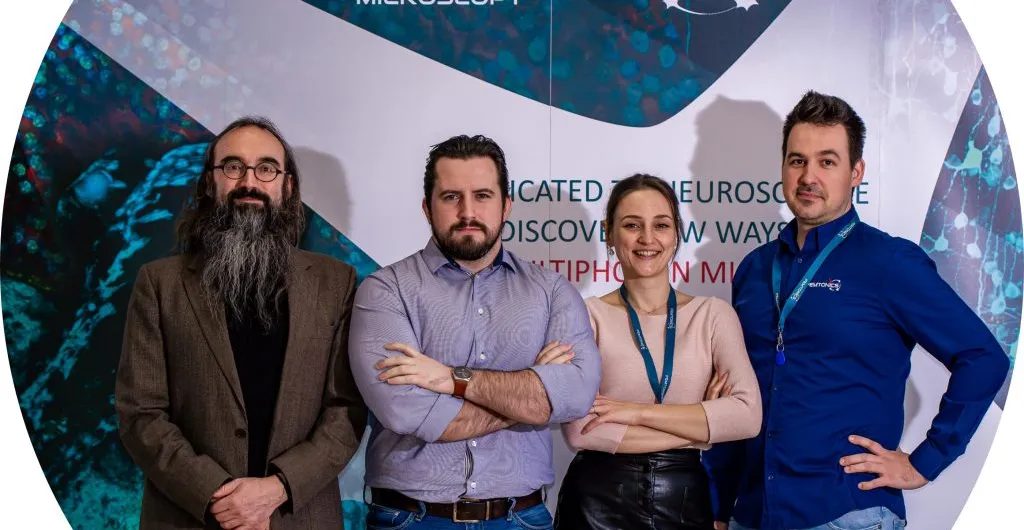
In the small Baranya county village of Kővágószőlős, an extraordinary technological breakthrough has been achieved. Budapest-based Femtonics Ltd., a company with a modern R&D facility in the village, has completed a project of global significance: the development of a high-resolution microscope system designed to support medical research, in particular neuroscience. The three-year project, presented at a recent closing event in Kővágószőlős, was carried out with the co-financing of the European Union’s Cohesion Fund.
Femtonics, founded in Hungary and still wholly Hungarian-owned, successfully concluded its latest development programme, launched in February 2022, with more than HUF 393 million in non-repayable support from the EU’s Cohesion Fund under the Széchenyi Plan Plus scheme.
The company’s core expertise lies in the design, manufacture and marketing of specialised two-photon laser scanning microscopes and their auxiliary devices, serving primarily international research markets. With two decades of history, the firm has built its reputation on the intersection of optics and quantum mechanics, creating world-leading microscope systems that allow scientists to observe neuronal activity in living, behaving animal models. Employing around 150 people, Femtonics was the first in the world to bring real-time 3D acousto-optic scanner-based laser scanning microscopes to market, and it continues to lead this highly specialised field.
Mapping hidden patterns in the brain
The company’s three-dimensional imaging technology enables researchers to explore fundamental questions in neuroscience. It makes it possible to map complex activity patterns that had previously remained hidden, both in healthy brains and in those affected by neurological disorders in rodent models.
Faster and more accurate data processing
The project, officially titled GINOP_PLUSZ-2.1.1-21-2022-00143, set out to integrate novel software and electronics into the microscope systems, thereby significantly enhancing their performance and opening new horizons for neuroscience.
At the heart of the work was the innovative combination of image analysis with cutting-edge electronic technology. Developments such as pulsed lasers and time-correlated single-photon counting—a highly sensitive optical measurement technique also used for studying dynamic processes—have improved the speed and accuracy of the microscopes’ detector electronics. The result: real-time images with a better signal-to-noise ratio, enabling more efficient detection of photons from biological samples. This also means that lower laser power is sufficient for tissue examination, reducing the risk of damaging the living cells under study.
The project also produced new data acquisition and control cards, further improving system efficiency. These were accompanied by a dedicated testing station and specialised software, ensuring reliability and robustness in research use.
Pushing the physical limits of brain research
While earlier versions of Femtonics microscopes already pushed the boundaries of what was technically possible, this project succeeded in extending those limits further, both in hardware and software.
By combining the newly developed technologies, researchers can now measure neuronal activity in living, behaving animal models with greater precision, at greater depth, and at larger scale than before. This represents a significant step forward in functional brain research and could accelerate studies in key areas such as memory, Alzheimer’s disease, dementia and epilepsy.
Commercial impact alongside scientific breakthroughs
Beyond its scientific significance, the new system developed in Kővágószőlős is expected to deliver tangible financial returns for the company in the short term. Its suite of innovations makes it a compelling proposition for leading research institutions worldwide. Unsurprisingly, some of the world’s most prestigious universities and medical centres have already ordered Femtonics microscopes. Among its most important customers are the Boston Children’s Hospital (affiliated with Harvard University), MIT, Columbia University and Yale University. The company’s largest sales take place in the United States, Canada and EU countries.
With the successful conclusion of this EU-backed project, Femtonics has reinforced not only its position as a global leader in high-resolution neuroscience imaging, but also Hungary’s place on the map of cutting-edge medical research technology.
(Source: szabadpecs.hu)

Funded by the European Union. Views and opinions expressed are however those of the author(s) only and do not necessarily reflect those of the European Union or European Commission. Neither the European Union nor the granting authority can be held responsible for them.

