


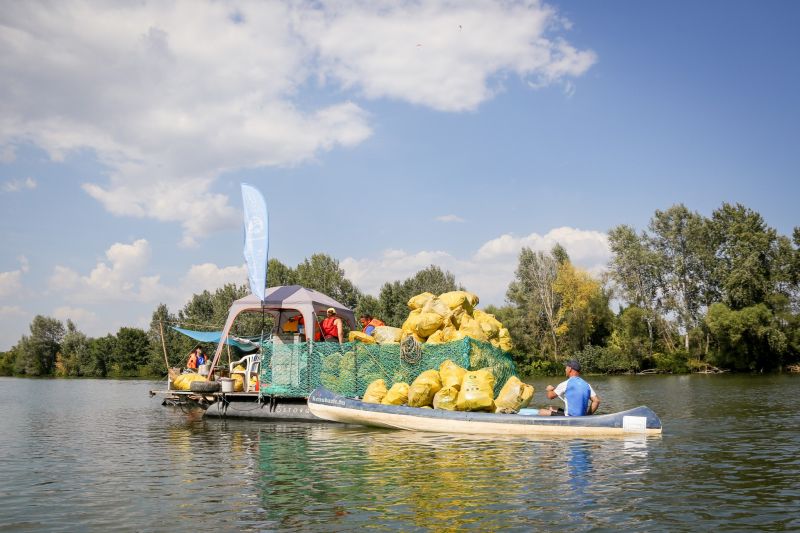
Throughout 2024, the Bodrog and the Tisza drew considerable attention. Volunteers of the PET Cup removed several tonnes of waste from the rivers, while studies revealed alarming levels of microplastics in their waters. At the same time, the Bodrog is cherished by Slovak communities as well. Beyond these challenges, the rivers and their surroundings hold enormous potential for regional development—potential that can be realised through cross-border cooperation, supported by the European Union.
At the heart of these efforts is the FloodBOTI project, its name derived from the English word flood and the initials of the Bodrog and Tisza. The scheme is not limited to flood protection: equal emphasis is placed on restoring wetlands and tackling invasive plant species. Improving water management stands as a central mission, but so too do community initiatives such as river clean-ups and environmental restoration.
The project began in July 2024 under the Interreg programme, co-financed by the EU. Interreg is one of the Union’s key regional development instruments, designed to promote cross-border collaboration between member states and, in many cases, their neighbours.
The risks are clear. After heavy rainfall, both the Bodrog and the Tisza are capable of bursting their banks and unleashing devastating floods. Climate instability has only heightened the danger: in recent years, weather patterns have become increasingly erratic, with astonishing volumes of rain now able to fall within minutes. Floodwaters threaten not only fragile ecosystems but also local communities.
Hungarian and Slovak water authorities face the same challenges, which makes close cooperation indispensable—particularly since Hungary is a downstream country, with much of its rivers’ catchment areas lying abroad. Guided by the principles of joint development, execution, management and financing, the project foresees aligned technical solutions and interventions on both sides of the border, promising shared environmental and conservation benefits. These include a more balanced water regime, the creation of sustainable, semi-natural conditions, and the enhanced retention of smaller flood waves in floodplains and oxbows. Education and awareness-raising activities will underscore the importance of protecting our environment.
Although the initiative was officially launched in June 2024, with the Grant Agreement signed in August, the North Hungarian Water Directorate (ÉMVIZIG) told Borsod24 that the project remains in its preparatory stage, including the procurement process. The choice of the Tisza section between Tiszadorogma and Ároktő was made both for technical reasons and because, as the Directorate explained, “according to professional guidelines, a watercourse or floodplain section must be rehabilitated from downstream upwards.” This section is the lowest part of the Tisza overseen by ÉMVIZIG.
While the programme does not directly cover the Hungarian stretch of the Bodrog, the Directorate stressed its commitment to the smaller river and its visitors.
“We seek to take advantage of every possible grant to make our rivers more liveable. On the Bodrog, we are actively engaged in the DALIA Danube Light House project, an international collaboration aimed at eliminating municipal waste from rivers. Here, the Hungarian stretch of the Bodrog serves as a pilot site, where multiple annual clean-up campaigns will target the flood of plastic pollution. Given that waste contamination of our rivers and floodplains is such a serious problem, we also have development plans to address it—specifically by adapting existing flood protection facilities on the Bodrog and Tisza to localise and remove solid waste carried in from abroad,” the Directorate explained.
ÉMVIZIG also pointed out that restoration and afforestation works have been carried out regularly in past years, and that passers-by and residents alike have been struck by the landscape’s beauty.
“Our experience is that people are gradually rediscovering and beginning to use the landscape—whether for fishing, hiking, sport or recreation. Our Directorate strives to serve society’s diverse needs related to water, and in doing so we seek to build consensus with all stakeholders,” they added.
(Source: borsod24.hu)

Funded by the European Union. Views and opinions expressed are however those of the author(s) only and do not necessarily reflect those of the European Union or European Commission. Neither the European Union nor the granting authority can be held responsible for them.

