


Author: Krisztina Nagy
One of the European Union’s fundamental objectives is to reduce disparities in development among its member states. To this end, the cohesion policy was established, driven primarily by the Cohesion Fund and the European Regional Development Fund. Significant sums from these funds flow to Hungary, particularly to less-developed regions.
While the Hungarian government frequently criticises Brussels and the EU, it rarely emphasises that many rural development projects could not have come to fruition without EU support. Across the country, countless initiatives in recent years have been made possible largely—or even entirely—thanks to cohesion funds.
Why Hungary Benefits from Cohesion Policy
Hungary has emerged as one of the largest beneficiaries within this system. The country receives more from the EU budget than it contributes, with a theoretical calculation for the 2021–2027 period suggesting an annual per capita benefit of €1,580. However, a significant portion of this funding is currently frozen: the European Commission has suspended disbursements over concerns related to the rule of law, posing the risk of prolonged financial losses should these issues remain unresolved.
For the 2021–2027 cycle, the EU has outlined eleven development-policy priorities, including innovation and research & development, support for small and medium-sized enterprises, green transition and climate adaptation, infrastructure and transport development, social inclusion and education, and public administration modernisation. Member states are free to prioritise among these areas in their national programmes. In Hungary, funds have primarily been directed toward infrastructure and employment initiatives, while research, innovation, and green projects have received proportionally less support.
Seven Major Operational Programmes in Hungary
Hungary channels EU cohesion funds through seven key operational programmes in the current cycle:
- GINOP+ – Economic Development and Innovation Operational Programme Plus: HUF 2,101.3 billion
- TOP+ – Territorial and Settlement Development Operational Programme Plus: HUF 1,962.5 billion
- IKOP+ – Integrated Transport Development Operational Programme Plus: HUF 1,559.7 billion
- KEHOP+ – Environmental and Energy Efficiency Operational Programme Plus: HUF 1,552.1 billion
- EFOP+ – Human Resources Development Operational Programme Plus: HUF 1,278.4 billion
- DIMOP+ – Digital Renewal Operational Programme Plus: HUF 732.3 billion
- VOP+ – Implementation Operational Programme Plus: HUF 301.1 billion
While public discourse often focuses on alleged misuse, inefficiency, or disproportionately small projects funded by large sums—a phenomenon colloquially referred to as “kickbacks”—less attention is given to cases where the funds are effectively deployed. In reality, EU support has produced tangible, highly beneficial outcomes. Many rural developments simply could not have been realised without these funds, which in numerous cases cover 100% of project costs.
Not Just Stadiums: Roads, Cycle Paths, and Roundabouts Funded by the EU
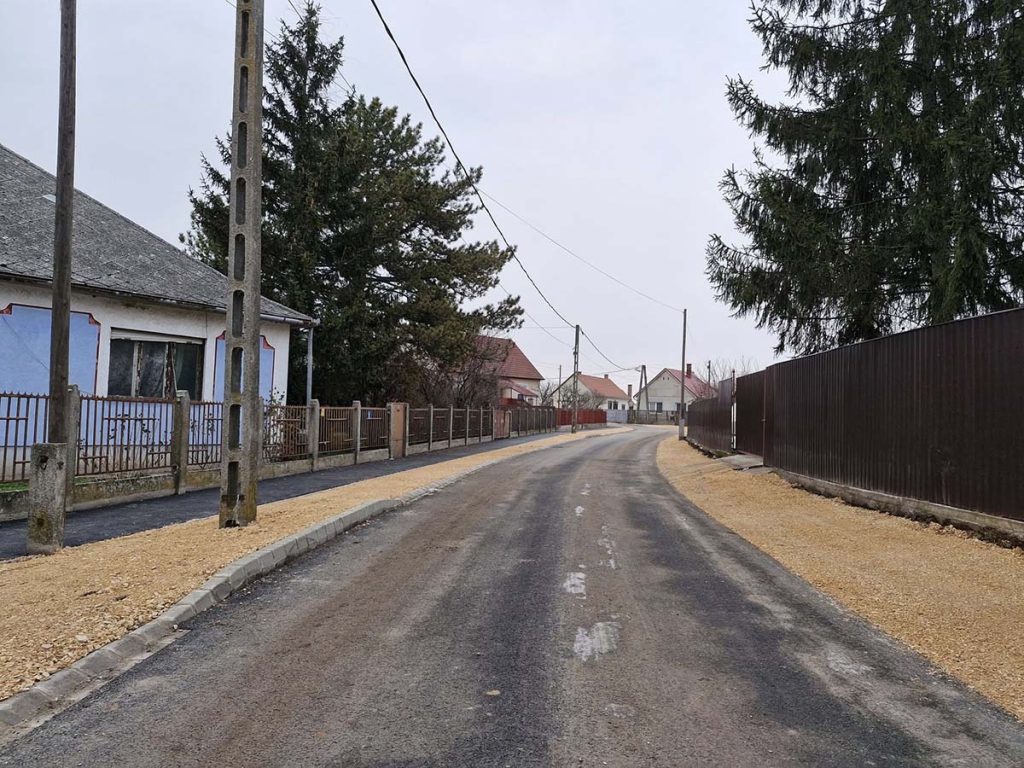
The Cohesion Fund has played a pivotal role in developing infrastructure across Hungary, funding numerous transport projects in recent years. In many rural settlements, the long-overdue asphalting of dirt roads could only take place thanks to multi-million-euro EU support. Existing roads were renovated, new roundabouts built, cycle paths established, and other infrastructural improvements implemented.
For instance, Kazincbarcika used €530,000 in EU support in 2024 to upgrade more than 2.5 kilometres of inner-city roads across four districts. The project aimed to modernise poorly maintained roads, enhance traffic safety, and improve connectivity within the city. Without EU funding, the municipality could not have carried out this essential upgrade.
In Vámospércs, where 60% of streets remain dirt roads despite a population of over 5,000, EU support has already enabled the paving of several streets. With €780,000 from TOP Plus, further roadwork is planned, ensuring that residents enjoy not only improved transport but also a higher quality of life. Local authorities stress that minimal progress had been made in past decades, and these EU-funded interventions mark a genuine step forward.
In Hajdúsámson, long-overdue road improvements have finally taken place thanks to cohesion funding: eight streets are being paved with solid surfaces under the TOP Plus programme, supported by over HUF 345 million. This brings a significant improvement to local transport and overall quality of life. The financing is 83% EU-funded and 17% covered by domestic sources, although the local mayor primarily expressed gratitude to the Hungarian government and the parliamentary representative, mentioning the EU support less prominently.
In Miskolctapolca, roads have also been upgraded through the TOP Plus programme: more than three kilometres of streets were renovated using HUF 1.7 billion in EU funds. Key elements of the project include the full reconstruction of Miskolctapolcai Road, connecting the city centre to the spa district, as well as upgrades several smaller side streets. The roadworks not only laid new, durable surfaces but also renovated drainage systems, installed sidewalks, and completed curb and roadside works. As part of the project, dedicated bike lanes and cycle paths were constructed on the refurbished sections, serving both daily commuters and cycling tourists alike.
In Siklós, complex projects have been underway, combining cultural upgrades with transport infrastructure improvements, funded through the TOP Plus programme with a 300 million forint EU grant. To enhance road safety, a new roundabout is being constructed at the Gyűdi Road – Felszabadulás Street – Harkányi Road junction. The compact single-lane roundabout is designed to allow smooth passage for articulated buses and large trucks. Similarly, a traffic-calming island is being built in the western part of Máriagyűd, reducing vehicle speeds and making inner-city traffic in Siklós safer. Work on the transport development component is scheduled to begin before summer and is expected to conclude by early 2026. The EU covers 100% of the funding, meaning the local government did not need to contribute financially.
Siklós and Hajdúböszörmény are both seeing significant upgrades to their cycling infrastructure too through EU-funded projects under the TOP Plus programme. In Siklós, a 2.4 km rural bike path linking Máriagyűd to Villány is being built with 350 million forints from the cohesion fund, improving local commuting, leisure cycling, and regional tourism. Meanwhile, Hajdúböszörmény is adding two new paths—one towards Debrecen-Józsa, the other towards Hajdúdorog—supported by 2.3 billion forints, creating safe connections between key towns. Financed mostly by the EU, these developments enhance traffic safety, environmental sustainability, and residents’ recreational opportunities, with completion expected by 2026.
Overall, the EU cohesion policy has delivered tangible results across many regions of Hungary. Without these funds, numerous rural communities would still be grappling with dirt roads, outdated infrastructure, and delayed development. These investments not only enhance local quality of life but also generate long-term benefits across traffic safety, tourism, and environmental protection. While political debates around EU funding often focus on accountability, rule-of-law disputes, and frozen payments, it is important to remember that, in most cases, these developments would not have been possible without European support.
Funded by the European Union. Views and opinions expressed are however those of the author(s) only and do not necessarily reflect those of the European Union or European Commission. Neither the European Union nor the granting authority can be held responsible for them.

