

Hungary is often celebrated as the “land of waters,” a country blessed with abundant water resources and remarkable natural endowments. Yet beneath this picturesque label lies a sobering reality: the nation’s water utility networks—particularly in wastewater treatment, water management, and purification—have lagged decades behind, necessitating urgent modernisation to safeguard both environmental standards and the livability of its settlements. In recent years, however, the tide has begun to turn, thanks to significant development initiatives financed by the European Union.
At the heart of these initiatives lies the EU’s cohesion policy. Through the Cohesion Fund and the European Regional Development Fund, Hungary has received substantial resources, particularly targeted at its less-developed, disadvantaged regions. One of the EU’s principal objectives is to narrow the developmental gap between member states.
Public attention often gravitates toward misuse, corruption, or disproportionately expensive projects. Yet, less celebrated are those investments where EU funding has yielded tangible, community-serving results. A case in point can be found in recent water utility developments, implemented under the KEHOP+(Environmental and Energy Efficiency Operational Programmes) programme.
What is KEHOP+ (Environmental and Energy Efficiency Operational Programmes), and What Does it Fund?
KEHOP+, the Environmental and Energy Efficiency Operational Programme Plus, stands as one of Hungary’s most pivotal operational programmes within the EU’s 2021–2027 budget cycle. Funded via the Cohesion Fund and the European Regional Development Fund, the programme aims to facilitate Hungary’s green transition and climate adaptation while modernising environmental infrastructure.
KEHOP+ focuses on four main areas: improving water management, enhancing energy efficiency, developing environmental infrastructure, and adapting to climate change. Water-related projects encompass flood and inland water protection, water retention and replenishment systems (such as the Civaqua programme in Debrecen), and upgrades to wastewater and drinking water treatment. Energy efficiency initiatives include modernising public institutions, deploying renewable energy, and upgrading street lighting.
The programme’s total budget is HUF 1,552.1 billion, 85% of which is EU funding, with the remainder covered by the Hungarian state. Beyond environmental sustainability and energy efficiency, KEHOP+ seeks to enhance quality of life, elevate public service standards, and pave the way toward long-term climate neutrality.
EU Funds Revitalise Pécs and Seventeen Surrounding Municipalities’ Wastewater Networks
Among the largest KEHOP+ water utility projects is the overhaul of Pécs and its surrounding areas’ wastewater management, with over HUF 8.1 billion invested, 90% financed by EU funds. Work commenced at the end of 2021, the funding contract took effect in February 2022, and construction concluded by the end of 2024.
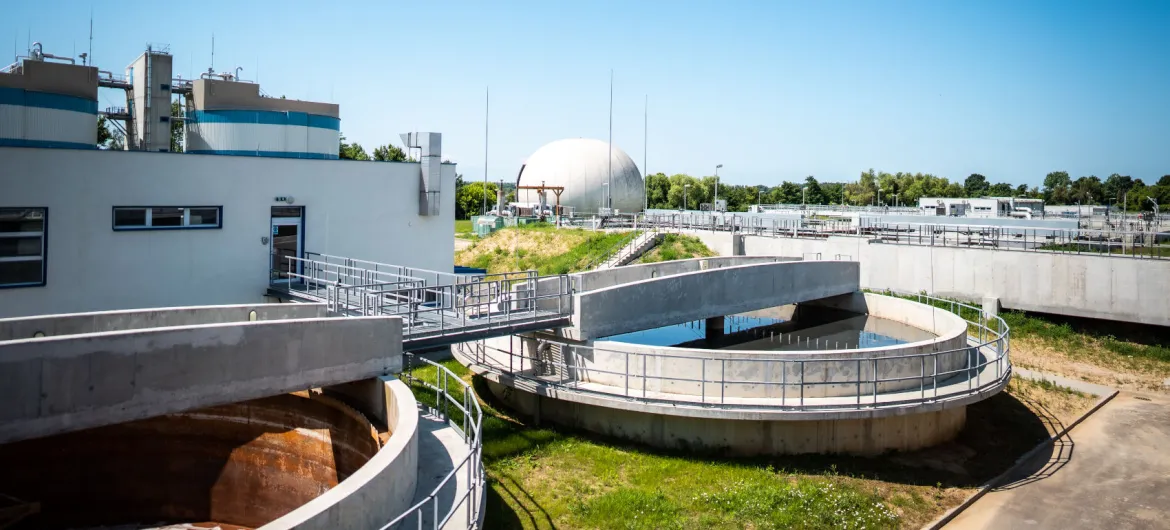
The project, focused on the Pécs agglomeration’s wastewater treatment plant, stands as one of the city’s most significant environmental upgrades in recent decades. The modernisation saw the construction of a 2,100-square-metre, six-metre-deep biological treatment facility, complemented by a new mechanical treatment line featuring screening, grit removal, and primary sedimentation. With these cutting-edge technologies in place, incoming wastewater is now processed far more efficiently and cost-effectively.
This long-overdue investment was essential both technologically and environmentally. Pécs and its surrounding settlements sit atop particularly sensitive water basins, and the previous treatment system—dating back to the 1980s—was ill-equipped to handle population growth or meet stricter environmental regulations. The project therefore went beyond mere renovation, expanding the network to allow smaller neighbouring municipalities to connect, ensuring a more resilient and comprehensive wastewater infrastructure for the entire region.
Today, the upgraded facility serves not only Pécs but seventeen additional municipalities, providing daily water treatment for nearly 160,000 residents. The project has raised wastewater treatment efficiency from 96% to virtually 100%, all while the plant remained operational throughout the works.
Originally budgeted at HUF 7.17 billion, the project’s final cost escalated to approximately HUF 8.1 billion due to price adjustments during construction. Ninety percent of the funding came from the EU and the Cohesion Fund. The goal was clear: improve water quality, enhance environmental safety, and ensure sustainable, cost-effective operation for the long term.
The project extended beyond the treatment plant itself. In Pécs, twelve streets’ wastewater networks were constructed or upgraded. Surrounding villages received complete sewer systems. In Kozármisleny, the existing network was expanded, while three old main collectors in Pécs were upgraded, and a smaller network reconstruction ensured the proper routing of wastewater from surrounding settlements to the modernised Pécs plant.
The societal impact has been significant. Residents in the affected streets and municipalities long awaited reliable sewer connections. Although construction, particularly in Pécs Kertváros, caused traffic disruptions and road excavations, these civil engineering works promise enduring environmental and quality-of-life benefits. The expanded and modernised system is now operated by Tettye Forrásház Zrt., the region’s water utility provider, delivering reliable service across an even wider area.
Four Water Management Buildings Modernised in the Southern Transdanubia
Under a comprehensive development programme, four buildings belonging to the Southern Transdanubia Water Directorate underwent energy efficiency upgrades, supported by HUF 181.85 million in non-repayable EU funding. The project encompassed four sites: the Pécs District Office, Mohács Protection Centre, and the Nagyatád and Sásd Supervisory Buildings. These institutions are not merely administrative centres; they are pivotal bases for regional flood defence, water utilisation, and disaster management operations.
The project aimed to boost energy efficiency and the share of renewable energy, in line with Hungary and the EU’s long-term climate commitments. Extensive technical modernisation was undertaken: full window replacement, façade and ceiling insulation, drastically reducing heating costs and enhancing energy performance. Additionally, modern, energy-saving LED lighting replaced outdated fixtures.
A standout achievement occurred at the Pécs District Office, where solar panels were installed, raising both energy efficiency and the facility’s energy independence. The Pécs project concluded in summer 2023; the Mohács renovation followed in autumn, and the upgrades in Nagyatád and Sásd were completed by late November 2023.
This initiative, part of KEHOP+, exemplifies the programme’s focus: climate adaptation, sustainable use of natural resources, and enhanced energy efficiency. Renovating state-owned buildings not only reduces budgetary pressures but also represents a forward-looking step toward a climate-neutral Hungary.
Far from mere refurbishment, these projects embody environmental responsibility, prudent public spending, and a commitment to sustainability. The affected buildings had long been overdue for renovation; failure to act would have led to higher operating costs and jeopardised institutional efficiency in the long run.
Debrecen’s Civaqua Programme: EU Support Launched, but Future Remains Uncertain
The Civaqua programme sought to address Debrecen’s water management challenges, aiming to restore ecological balance and bolster agricultural water supply in the region. The first phase, funded entirely by KEHOP+ EU resources, was inaugurated in November 2023: Tisza River water was diverted through the Eastern Main Canal to Debrecen, reaching the Tócó Stream. This section alone cost HUF 16 billion.
Subsequent phases were even more ambitious: the second phase aimed to secure water supply for the Nagyerdő forest, while the third targeted replenishment for the Erdés-Puszta lakes, including Vekeri and Fancsikai. Although detailed plans were prepared during the first phase, political and financial obstacles have slowed implementation.
In March 2024, László Papp, mayor of Debrecen, announced that the second and third phases of Civaqua had been included in the KEHOP+ development framework. The National Water Directorate and the Tisza Region Water Directorate could thus access up to HUF 40.46 billion in EU funding. Yet, with the suspension of EU payments, the continuation of these phases remains uncertain.
Funded by the European Union. Views and opinions expressed are however those of the author(s) only and do not necessarily reflect those of the European Union or European Commission. Neither the European Union nor the granting authority can be held responsible for them.

