


Water loss in Kecskemét currently stands at around 15–16 percent. Across the entire drinking water network operated by BÁCSVÍZ Plc., losses reach 20 percent, while in some municipalities such as Martfű and Öcsöd the figure exceeds 30 percent. Hungary’s annual drinking water production amounts to approximately 640 million cubic meters, of which a quarter is lost. To put this into perspective: such a volume would be enough to fill nearly 10 percent of Lake Balaton. According to a report published in 2024 by the State Audit Office, water worth 17 billion forints vanishes each year due to pipe bursts and hidden leakages.
This is happening despite the widely known water protection directive, which declares that water is not an ordinary commercial product but a heritage resource that must be safeguarded, protected, and managed accordingly. Yet the renewal of Hungary’s water utility infrastructure is progressing at a painfully slow pace. Experts agree that far more funding is required—from state and EU sources, and increasingly also from corporate and residential contributions.
BÁCSVÍZ, which provides water services in 58 municipalities across three counties, has in recent years only been able to implement significant improvements thanks to EU cohesion funds. Still, these cover only a fraction of the company’s real needs, forcing management to consider how to generate revenue beyond water and sewage tariffs. Over time, they have built up a secondary business line worth 2 billion forints annually, providing water quality analyses for spas, industrial plants, and other utilities—a service highlighted by Chairman and CEO Viktor Kurdi in an earlier in-depth interview with KecsUP Hírek.
When we spoke with him again, the focus was on EU-funded projects completed over the past three years. These were carried out in two supply zones in Kecskemét, across three phases, at the city’s Waterworks Plant No. I and in Ballószög, all with the aim of reducing water loss and improving the energy efficiency of water utility services. The total project cost exceeded 1.8 billion forints, of which 1.285 billion forints came in the form of non-repayable EU support.
On the network upgrades, Kurdi explained:
“In the two Kecskemét supply zones involved—Zone 1 (Ipoly Street to Betonkeverő Street) and Zone 2 (Mártírok Road to Szent István Boulevard)—the specific minimum night consumption (a measure that includes not only hidden leakages but also potential other withdrawals) fell from 0.48 m³/h/km to 0.31 m³/h/km. For these pipeline sections, that translates into an annual reduction of 19,000 cubic meters. In percentage terms, we are talking about a 35 percent decrease in the minimum night value.”
He added that the improvements also increased supply security and eliminated costly repairs associated with burst pipes—representing further savings.
While maintenance is important, scheduled replacement of pipes is essential. Water loss through leakage, bursts, and illegal use not only wastes drinking water but also causes severe financial losses to providers. A hole just 1 mm in diameter in a trunk line can leak some 500 cubic meters of water per year; at 3 mm, the figure rises to 4,200 cubic meters. The causes of bursts are many: besides pipe age and material quality, dynamic loads such as nearby railways, roads, heavy vehicle traffic, or construction works involving earth movement can all contribute. Under such stress, old pipes can rupture explosively.
A New Era for the Water Utility Sector
While consumers may not have noticed, January 1, 2024, marked a turning point for providers. With Decree 25/2023, the Minister of Energy ushered in a new era for Hungary’s water utility sector. The legislation set a nationally uniform tariff for non-residential water services, ensuring coverage of justified costs and making long-overdue reconstructions possible. “The backlog is enormous, but at least we can now feel the first push upward from the bottom of the pit,” noted Kurdi, who also serves as President of the Hungarian Water Utility Association (MaVíz).
The change was urgently needed. By 2023, the situation had become unsustainable, demanding immediate funding injections. A new national fund was therefore created, drawing money from three sources: 100–120 billion forints from the central budget, 150 billion forints from non-residential tariffs, and contributions from utilities operating in the most industrialized areas (such as Budapest and Szeged). The decree also mandated how much providers must allocate to infrastructure maintenance, reconstruction, and replacement. For BÁCSVÍZ, this means more than 4 billion forints annually, supported by 1.2 billion in state aid, with the remainder to be covered from its own resources—chiefly from the standardized, inflation-adjusted non-residential payments, which are now roughly triple their pre-2024 level.
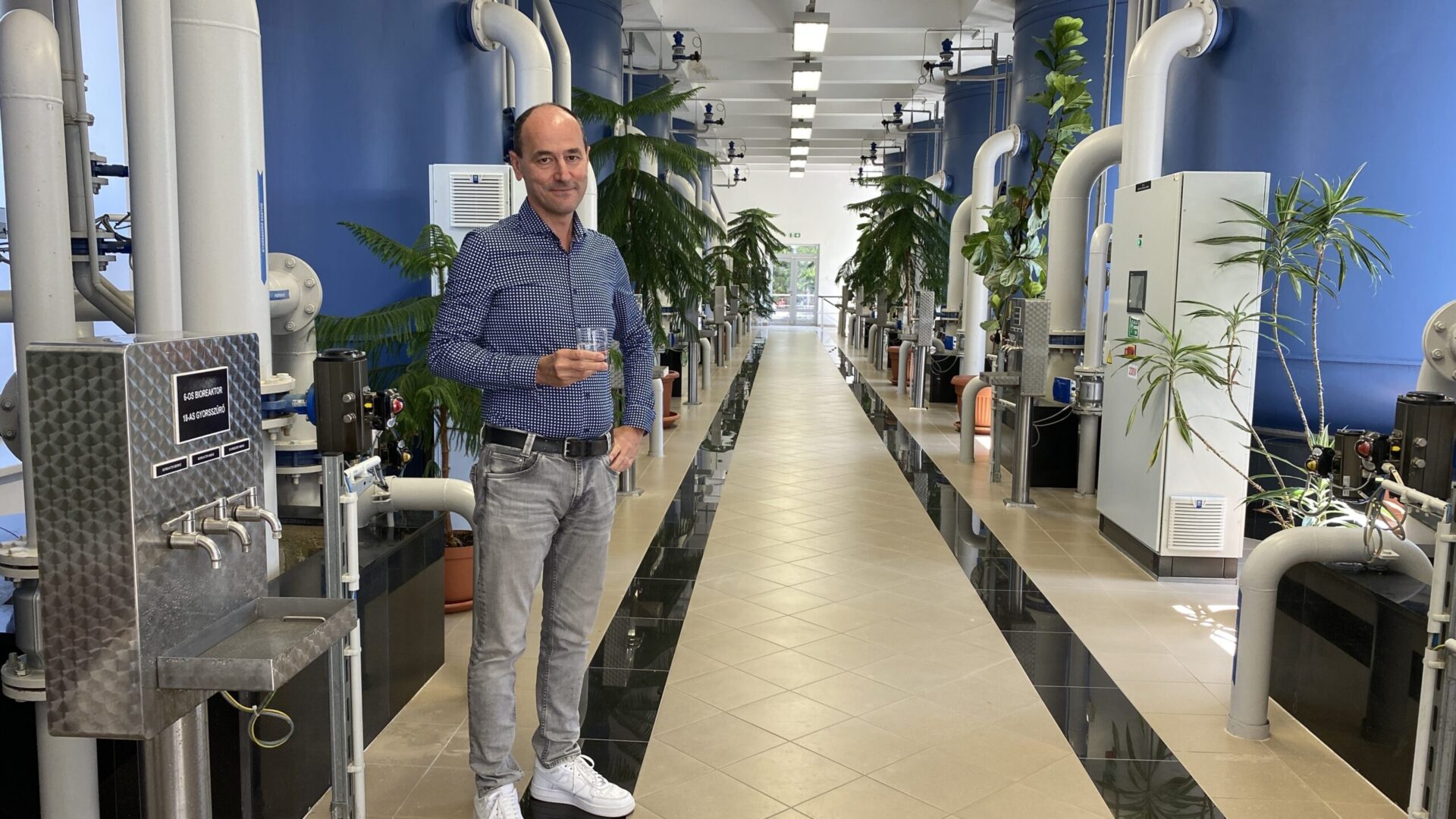
“From a technical perspective, our room for maneuver has improved significantly. We can now pursue a sustainable strategy to reduce network water loss,” summarized Kurdi, as he guided us through the upgraded Waterworks Plant No. I. He highlighted three major achievements of the completed project:
- 8 percent energy savings (60 MWh annually) on the high-pressure system, worth nearly 5 million forints each year.
- 127 MWh of renewable solar power generated since commissioning, translating into savings of close to 10 million forints.
- Over 50 percent reduction in chemical use, notably saving 6,000 liters of ferric chloride annually.
(Source: kecsup.hu)

Funded by the European Union. Views and opinions expressed are however those of the author(s) only and do not necessarily reflect those of the European Union or European Commission. Neither the European Union nor the granting authority can be held responsible for them.

