


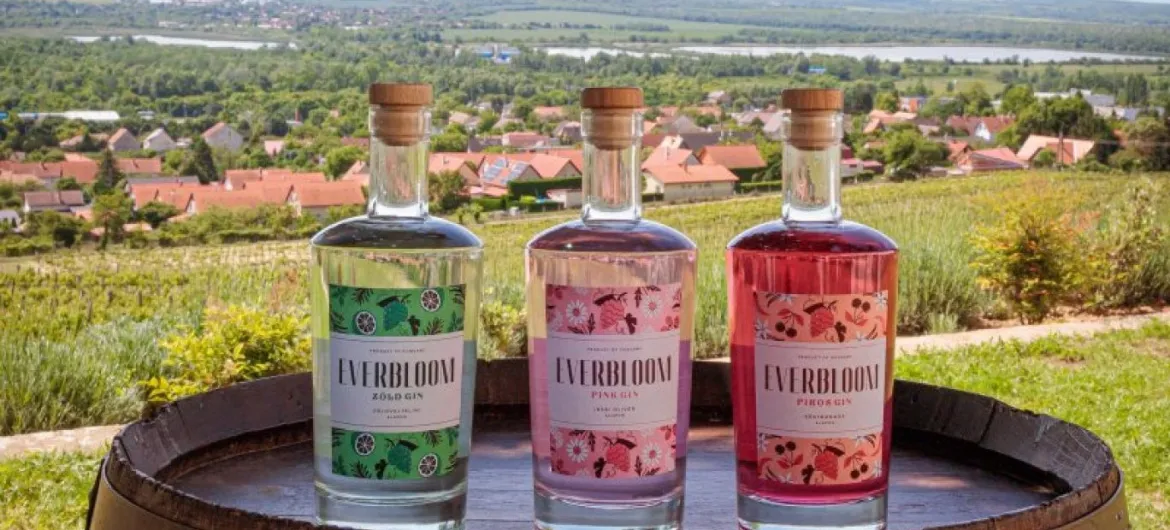
It may not be common knowledge exactly what ingredients go into some of the world’s most well-known spirits. While it is widely understood that bitters derive their flavors from herbs, that tequila comes from agave, and that juniper berries—or their extracts—are the defining flavor of gin, few would imagine that grapes could also be used in gin production. Yet a recent Hungarian research project has done precisely that.
In fact, a small team of innovators had the idea that grapes—and even specific parts of the grape, such as seeds, leaves, or stems—could be used to flavor gin. They wrote a proposal, submitted it, and ultimately received support from the European Union. The result is not just a single new Hungarian gin, but a whole new gin product family, comprising three distinct gins with unique flavors, characteristics, and colors.
The team conducted extensive laboratory analyses and industrial-scale trials, comparing traditional grape varieties with new, innovative cultivars developed through the PTE SZBKI resistance-breeding program for use as gin ingredients. The project culminated in three commercially viable gins—“Green Gin,” “Pink Gin,” and “Red Gin”—along with the necessary production technology.
The successful EU-backed project was implemented as a consortium by one of Hungary’s largest wine companies, Danubiana Ltd.—majority-owned by German investors and headquartered in Bonyhád—and the University of Pécs (PTE). The project also involved a distinguished distillery, Brill, based in Harc, Tolna County, as a professional partner.
Ready for Market Launch
Thanks to the winning project, titled “Research on Grape-Based, Aroma-Preserving, Extra-Fragrant New Gin Products and Gin Technology,” Hungary has, for the first time, developed three unique grape-based gins using innovative grape-processing techniques. By the end of the research and development program, the products had achieved commercial release standards. However, as Szabad Pécs learned from Győző Schmidt, CEO of Danubiana Ltd., the official project closure and accounting are still pending, as is the market launch of the products. According to Schmidt, only the final authorization process remains before the Danubiana gins, presented in elegant bottles, can be made available to the public.
Notably, this concerns one of the largest and most successful wine companies in the Pannon wine region, with wineries in Bonyhád and Gyöngyös producing 10 million bottles annually and exporting to 178 countries worldwide. These commercial networks will now also be leveraged to introduce their new gin not only to the Hungarian market but internationally. Thus, the project has produced not just a new Hungarian gin and gin family, but potentially the start of a new Hungarian international success story.
Schmidt Dezső also explained that it was the University of Pécs and Brill Distillery that approached them with the idea of creating gin from grapes or parts thereof—more precisely, a gin flavored with grape distillate. Since Danubiana’s gins already comply with international gin regulations, using grain spirit as a base and including juniper berries, the idea was feasible. While the concept was not originally theirs, Danubiana contributed significant value through its large-scale winemaking expertise, vineyards, and the considerable own resources required for the EU application. Moreover, the project offers the potential to address or mitigate additional industry challenges.
The project was financed through EU cohesion funds (European Regional Development Fund) and the Hungarian central budget. The development of the new Hungarian grape-based gin received 429.8 million forints in non-repayable support under the Economic Development Operational Programme Plus (Ginop Plusz).
The total cost of the joint Danubiana Ltd. and PTE SZBKI project amounted to 750 million forints, of which 429.8 million forints came from support, including 378.225 million forints in EU funding, while Danubiana Ltd. covered 280.8 million forints. The project commenced in May 2022, and after nearly three years, the three new gins were finally unveiled—soon to be available in stores and bars, potentially worldwide.
Grape as a Gin Spice
Multiple innovative technologies were explored, culminating in a complex production process in which pH reduction played a central role. In parallel with determining optimal wine and spirit production methods, researchers investigated potential gin spices, examining the use of various grape parts—including flowers, leaves, berries, and seeds—as flavoring agents. This approach is unprecedented in both domestic and international practice and literature.
Extensive research was conducted to map the aromatic compounds and potential of both traditional and innovative grape varieties. The project’s research and professional foundation drew on Danubiana Ltd.’s large-scale winemaking expertise, Brill Distillery’s award-winning distillation experience, and the accredited laboratories and 70-year viticultural knowledge base of PTE’s Viticulture and Enology Research Institute (SZBKI).
(Source: szabadpecs.hu)

Funded by the European Union. Views and opinions expressed are however those of the author(s) only and do not necessarily reflect those of the European Union or European Commission. Neither the European Union nor the granting authority can be held responsible for them.

