


Krisztina Nagy, journalist
Rising tensions, nationalist rhetoric, and a controversial statement from Hungary are shaping the run-up to the second round of Romania’s presidential election: George Simion, the leader of the AUR party known for his anti-Hungarian remarks, is set to face off against liberal candidate Nicușor Dan – all while Viktor Orbán’s words of praise for Simion have sparked serious outrage among the Hungarian community in Transylvania.
The first round of Romania’s presidential election took place on May 4, with far-right nationalist George Simion, founder and leader of the AUR party, securing 40.96% of the vote. He will now face liberal candidate and Bucharest mayor Nicușor Dan, who ran as an independent and came in second with 20.99%. Since the announcement of the results, public tensions and confusion surrounding the election have only grown.
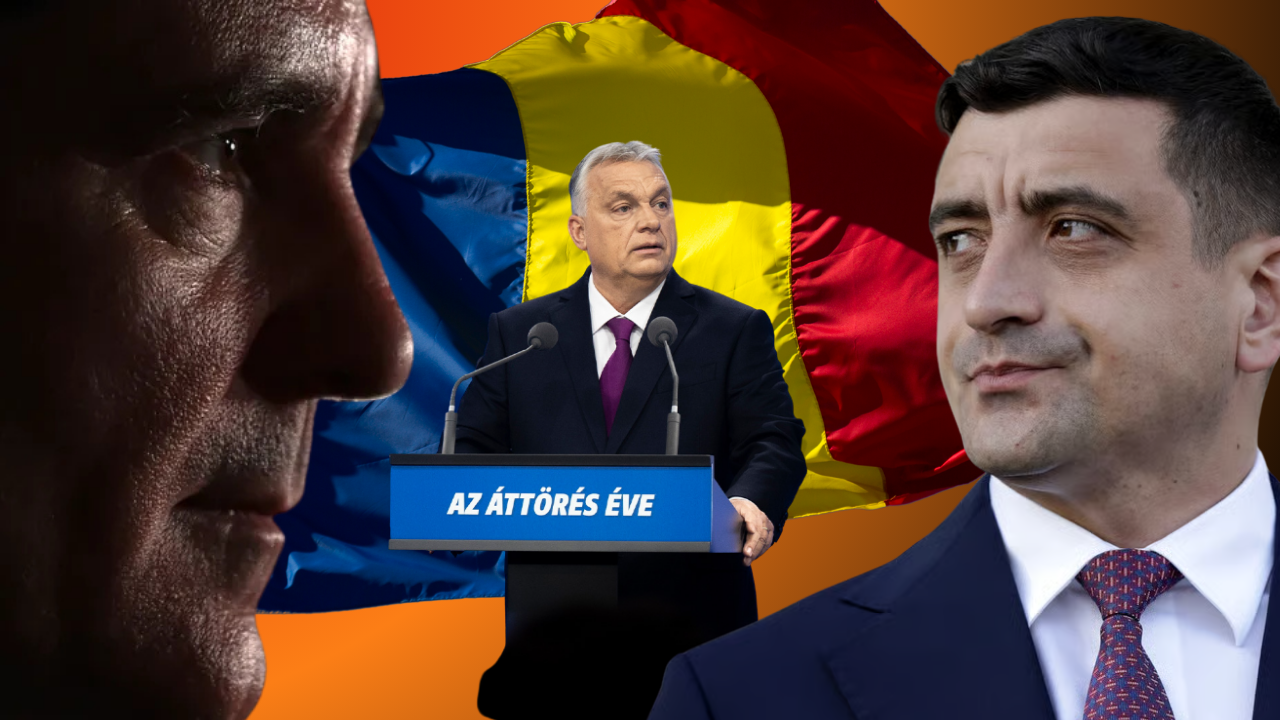
On May 9, in a speech delivered in the Tihany Abbey, Hungary, Viktor Orbán stirred further controversy by praising Simion — a candidate known for his anti-Hungarian rhetoric — causing a strong backlash among ethnic Hungarians in Transylvania. The runoff, set for May 18, is critical not only for Romania’s Hungarian minority, but also in a broader European context: it pits a far-right, pro-Russian, Trump-style populist against the Western-oriented liberal mayor.
Who Is George Simion – and Why Is He Dangerous?
On May 4, George Simion won a landslide victory in the first round of Romania’s presidential election, running as the candidate of the far-right nationalist AUR party. Simion is co-founder of AUR (Alliance for the Union of Romanians), established in 2020, a party that rose rapidly on the back of public disillusionment with the political elite and frustration during the COVID-19 pandemic. AUR is rooted in nationalism, EU-skepticism, and Orthodox Christianity, while also deepening social divisions across the country.
The party frequently questions the rights of ethnic minorities and often speaks out against them. Over the course of his political career, Simion has repeatedly made anti-Hungarian statements, openly opposing the use of the Hungarian language, Hungarian schools, autonomy for Székely Land, and the display of Székely flags. One of the most notorious examples of his hostility was his involvement in the ethnic tensions surrounding the military cemetery in Valea Uzului (Úzvölgye), in Székely Land.
On June 6, 2019, Romanian nationalist groups—led by George Simion—forcefully entered the Valea Uzului cemetery, where mostly Hungarian soldiers are buried. The radicals came to “sanctify” newly installed Orthodox crosses, but the local Hungarian community viewed this as a desecration of the cemetery. The event turned violent: the crowd broke down the gate, threw stones and mud at Hungarians, and even climbed onto the wooden grave crosses. Simion had already played an active role in inciting the conflict beforehand, and continued mobilizing supporters in the name of “defending Romanian national values.”
Simion’s aggressive behavior and inflammatory rhetoric have become recurring features of his political persona. In 2024, during a heated parliamentary session, he physically confronted Senator Diana Șoșoacă by slapping the phone out of her hand and shouting at her: “I’ll rape you, you pig.”
Simion has also openly endorsed Călin Georgescu, who caused a major stir in November by winning the first round of Romania’s presidential election. However, the results were annulled after the Constitutional Court found serious irregularities, including foreign (primarily Russian) interference and illegal campaign financing. Georgescu was barred from participating in the repeat election. In response, Simion released a video in which he said the members of the Central Electoral Bureau (BEC) who blocked Georgescu’s candidacy “should be skinned alive in public.”
In another interview, Simion stated that, in case he wins the presidency, he would nominate Georgescu as prime minister. This is particularly alarming for the Hungarian community in Transylvania, as Georgescu is a known sympathizer of the fascist Iron Guard ideology. One of his most cited statements is: “Romania gives water and land to minorities — that should be enough.” He is currently under criminal investigation for inciting against constitutional order and promoting fascist propaganda. Nevertheless, Simion has made it clear that nominating Georgescu remains a key element of his political platform.
Orbán Didn’t Want to Interfere in the Romanian Presidential Election, But He Did it Anyway
The majority of ethnic Hungarians in Transylvania voted for Crin Antonescu, supported by the Transylvanian Hungarian party called RMDSZ (Democratic Union of Hungarians in Romania), in the first round on May 4. However; instead of Antonescu, Nicușor Dan, the independent candidate, secured a spot in the second round against George Simion. The day after the election, RMDSZ President Kelemen Hunor released a video urging ethnic Hungarians to vote for Nicușor Dan. In the video, Kelemen stated: “If Simion becomes president – and this is the great danger – and the AUR comes to power, our schools, our rights, and our language will be in danger.” Kelemen also emphasized that all arguments should be set aside because the primary goal now is to protect the rights of Hungarians.
In contrast, on May 9, during the inauguration of the renovated Tihany Abbey, Viktor Orbán addressed the Romanian presidential election and, to the surprise of many, spoke favorably about George Simion:
“Yesterday, during the debate among Romanian presidential candidates, Hungary was mentioned in connection with Christianity. One of the candidates, Mr. Simion, said: ‘Now it’s time for the Europe of nations, the Christian Europe, where we will fight for our right to be European citizens.’ This was not said in Hungary, but in neighboring Romania. We completely agree. We live in a historical community with the Romanians. We do not interfere in the ongoing Romanian presidential election struggle, but we want to send a message from here, from the heart of the Carpathian Basin, from this symbolic place, assuring the people of Romania and its future president that we stand on the ground of cooperation and unity, and therefore we will not support any isolation or political retaliation against Romania and its leaders. Both Hungarians and Romanians are full members of the European Union and will remain so. In the struggle for Christianity and sovereignty, we must rely on each other.”
Orbán’s speech caused significant outrage within the ethnic Hungarian community in Transylvania: many experienced it as a disappointment, even as betrayal, that the Hungarian prime minister did not raise his voice against the anti-Hungarian candidate but instead spoke favorably of him. This is particularly problematic for a politician who has previously attracted attention with his aggressive actions against Hungarians, openly questioning the necessity of Hungarian-language education, and limiting the use of the Hungarian language to family settings at most.
The day after Orbán’s Tihany speech, on May 10, Kelemen Hunor released another video in which, despite Orbán’s statement, he continued to urge ethnic Hungarians to vote for Nicușor Dan: “Simion is not our man. George Simion is anti-Hungarian. Simion is not a friend of Hungarians, and he will never be. Simion represents the principle in every fiber of his being that Hungarians have no place in Romania.” The video description subtly alludes to Orbán’s speech: “Simion is neither a sovereigntist nor a Christian, he is anti-Hungarian! We will not forget that he danced on our ancestors’ graves in Úzvölgye, and we will not forget that he attacked our mother tongue, our flags, and our symbols with hundreds of lawsuits.”
Current and former RMDSZ representatives also expressed their outrage over Orbán’s speech. Kedei Pál Előd, an RMDSZ councilor from Mureș County, compared the Tihany speech to the infamous 2006 “Őszöd speech” of Gyurcsány Ferenc. Markó Béla, former RMDSZ president, said on Klubrádió that Orbán’s speech was counterproductive: it was a huge mistake to speak favorably of Simion, thus disregarding the RMDSZ’s stance and the interests of ethnic Hungarians in Transylvania. Markó said that the Tihany speech caused significant confusion among ethnic Hungarians, and silence would have been a better option.
However, it wasn’t just politicians who spoke out against Simion. Church leaders also called for unity. Several leaders of historical Hungarian churches in Transylvania, including Roman Catholic, Reformed, Lutheran, and Unitarian bishops, issued a joint call asking their followers to participate in the upcoming elections and reject the extremist political candidate by voting for Nicușor Dan.
Following the widespread outrage, Orbán attempted to clarify his position in a May 10 Facebook-post, stating that he had consulted with Kelemen Hunor. “I made it clear: from Hungary, we do not wish to influence the Romanian presidential election in any way,” he wrote. Despite this, pro-government outlets have been publishing articles praising Simion’s Orbán-like politics, while painting Nicușor as anti-Hungarian: “Nicușor Dan, the liberal candidate, does not support the official use of the Székely flag, while George Simion would implement Orbán’s policies in Romania,” appears in a Mandiner article.
Orbán’s stance can be seen as problematic for several reasons. Some ethnic Hungarians in Transylvania trust him and Fidesz more than the RMDSZ. For them, Orbán’s statement may give the impression that George Simion is a more appropriate choice than the “Soros-agent,” liberal Nicușor Dan. There are even ethnic Hungarians who support Simion despite his anti-Hungarian narratives. This is partly because the political slogans and pejorative language he uses effectively create an image of the liberal candidate as an enemy. During the smear campaign, Simion referred to his opponent as a “Brusselsite,” “Soros-agent,” and “migrant-supporter,” while memes circulated portraying the liberal candidate as a puppet of Ursula von der Leyen, George Soros, and Emmanuel Macron.
This type of propaganda-based rhetoric, based on creating an “enemy image,” closely resembles Orbán’s media communication, posters, and slogans, which claim that Brussels, the Western political elite, and liberal ideas are enemies of the people, Christianity, and conservative values. However, many ethnic Hungarians fail to recognize that the real threat to them comes from George Simion, who is using Orbán-like communication tools to build anti-Hungarian sentiment in Romania, and yet Orbán speaks positively about him.
The question remains: is it more problematic for Orbán to pretend, “I wash my hands,” and say that he “doesn’t interfere” in the election that endangers the national rights of the largest ethnic Hungarian community abroad, or is it worse that, from the walls of the Tihany Abbey, he sends a message that he agrees with the anti-Hungarian presidential candidate, who is known for his anti-Hungarian statements and openly advocates restricting minority rights?
The situation is further complicated by the fact that George Simion’s political toolkit and rhetoric closely follow Orbán’s example, so paradoxically, the Hungarian prime minister may serve as a model for limiting the rights of ethnic Hungarians under the banner of nationalism. This is not surprising, as Simion has long considered Orbán Viktor a political role model.
George Simion and his Political Role Model: Viktor Orbán / The Simion – Orbán Bromance
Despite being controversial, George Simion, known for his anti-Hungarian remarks, has repeatedly spoken positively about Viktor Orbán. In a 2021 interview, Simion explained that he considers Orbán Viktor’s politics exemplary, especially because “he fights for his people.” When asked whether the term “wannabe Viktor Orbán” applies to him, he replied, “Yes. Although the ‘wannabe’ part is unnecessary. We share the same ideology.”
After the May 4, 2025 elections, Simion confirmed in several forums that he would align his political direction with Orbán’s. In an interview with Euronews, Simion stated, “In many respects, I would like to follow in Viktor Orbán’s footsteps,” but in the presidential debate, he even stronger stated, “Many of Orbán Viktor’s positions, not all, will become state policy in Romania.”
He made similar comments to BBC reporter Nick Thorpe, where he talked about a common “fight” on migration, demographics, and cultural issues: “We must unite our forces, fight against illegal migration, address demographic problems, and deal with woke and other neo-Marxist ideologies, which cause a lot of harm to both Romanians and Hungarians. Whether we want it or not, we live on the same land. We live in the same country or next to each other. We must write the future together.” Shortly after Orbán’s speech in Tihany, Simion reacted on X to the Hungarian Prime Minister’s words: “Thank you for your great message. We have a battle to win! Together!”
This rapprochement is particularly noteworthy considering that Fidesz had previously officially distanced itself from AUR. In 2023, Máté Kocsis confirmed that Fidesz did not join the Conservatives and Reformists (ECR) group because it includes extreme, anti-Hungarian AUR representatives, whose policies and anti-Hungarian remarks Fidesz could not identify with. Now, however, the situation seems to be changing. On Monday, several sources reported that Orbán and Simion have been contacted, signaling a new direction in this relationship.
Simion’s communication with Hungarians is extremely contradictory and confusing. While his sympathy for Orbán seems ideologically based, his statements praising the RMDSZ and emphasizing Romanian-Hungarian friendship appear more as political calculation. For example, he recently called the RMDSZ the only serious party among the Bucharest ruling parties, even though the RMDSZ is actively campaigning against him. His words opening up to Hungarians are likely as much campaign tricks as his promise of €35,000 apartments to Romanian citizens before the elections. He later explained that this was merely a “political marketing trick,” and without it, he wouldn’t have won more than 40% of the votes.
George Simion poses a threat not only to the minority rights of the Transylvanian Hungarian community: his extreme, nationalist political views go beyond ethnic issues. He openly supports Donald Trump, frequently criticizes the European Union, and his political rhetoric often includes pro-Russian tones. His views, which promote Romanian national superiority, claim that “harmful liberal ideas” must be suppressed, and he believes that the restoration of traditional, conservative values is the right path forward.
George Simion, “the Romanian Viktor Orbán”
Romania has already had a prime minister named Orban, but now it seems increasingly likely that it may have a president who identifies with Orbán—namely George Simion, who essentially considers himself the Romanian Viktor Orbán.
One of the core tenets of Viktor Orbán and his party, Fidesz, is national policy, and Fidesz politicians often emphasize how important they consider the interests of ethnic Hungarians living outside Hungary. Yet Orbán’s speech on May 9 in Tihany told a very different story. In it, the Hungarian prime minister declared his agreement on many issues with George Simion—despite Simion’s openly anti-Hungarian views. In our latest article, we analyzed the current situation and latest developments regarding the Romanian elections.
The Hungarian population of Transylvania has expressed outrage, feeling betrayed by Orbán’s praise for a politician known for his anti-Hungarian rhetoric—especially at a time when unity among Hungarians is more crucial than ever to stop the rise of the far-right nationalist Simion and to defend minority rights. With his words, Orbán has not only undermined the interests of ethnic Hungarians in Romania but also the position of the Transylvanian Hungarian party, called RMDSZ (Democratic Alliance of Hungarians in Romania), a long-standing ally of his, which is supporting another candidate—Nicușor Dan—and campaigning against Simion.
Although Simion’s admiration for Orbán is not new, until recently it appeared that Orbán was keeping his distance from the anti-Hungarian politician and his far-right party, AUR. That now seems to be changing.
The Simion–Orbán “Bromance”
Despite his well-documented anti-Hungarian statements, George Simion has repeatedly spoken favorably of Viktor Orbán, even going so far as to call himself the Romanian Orbán. In a 2021 interview, Simion said he considered Orbán’s policies exemplary, particularly because “he fights for his people.” When asked whether the term “wannabe Viktor Orbán” suited him, he responded: “Yes. Although the word wannabe isn’t even necessary. We share the same ideology.”
Following the May 4, 2025 elections, Simion reaffirmed in several forums that he would model his political direction on Orbán’s. In an interview with Euronews, Simion stated: “In many respects, I’d like to follow in Viktor Orbán’s footsteps.” During a presidential debate, he was even more direct: “Many of Viktor Orbán’s positions—not all—will become state policy in Romania.”
He echoed this message in a conversation with BBC reporter Nick Thorpe, where he spoke of a shared “struggle” on issues like migration, demography, and culture:
“We must unite our forces, fight against illegal migration, address demographic problems, and resist woke and other neo-Marxist ideologies that harm both Romanians and Hungarians. Whether we like it or not, we live on the same land. In the same country or side by side. We must write the future together.”
Shortly after Orbán’s Tihany speech, Simion posted a video of it on X (formerly Twitter), thanking the Hungarian PM for his supportive words: “Thank you for your great message. We have a fight to win! Together!”
This apparent rapprochement is particularly noteworthy given that Fidesz had officially distanced itself from AUR in the past. In 2023, Fidesz parliamentary leader Máté Kocsis confirmed that the party would not join the European Conservatives and Reformists (ECR) group because it includes representatives of AUR—an extremist, anti-Hungarian party whose politics and rhetoric Fidesz could not support. Yet somehow, the relationship now seems to be shifting. Multiple sources reported on Monday that Orbán and Simion have been contacted, possibly signaling a new direction.
Ironically, the Hungarian prime minister could now serve as a model for restricting the rights of ethnic Hungarians abroad, under the banner of nationalism. Simion has said he respects Orbán’s politics precisely because he “fights for his people”—yet it now appears he is fighting against his people, by aligning himself with their adversary.
Many ethnic Hungarians in Transylvania are left asking a troubling question:
Why does the prime minister of their “motherland”—who so often claims to support all Hungarians abroad—not stand up for the interests of the more than one million ethnic Hungarians in Romania in what could be a decisive political moment?
Simion’s Shifting Attitude Toward the RMDSZ
Simion’s messaging toward the ethnic Hungarian population of Transylvania has recently become increasingly contradictory and confusing. While his admiration for Orbán may appear ideologically driven, and he may indeed view Orbán as a political role model, his recent praise for the RMDSZ and calls for Hungarian-Romanian friendship within Romania seem more like political calculation.
For years, Simion opposed the goals of the RMDSZ and often expressed hostility toward the party—at one point calling it a “disgusting creation” and a “chauvinist” organization. Yet just days ago, in an interview with Euronews, Simion declared that the RMDSZ is “the only serious party” among Romania’s governing parties and said he was planning to partner with them. Meanwhile, the RMDSZ is running a strong campaign against him under the slogan #StopSimion.It’s quite clear that Simion’s nationalist, anti-Hungarian views haven’t transformed overnight into genuine pro-Hungarian sentiment. His recent overtures toward Hungarian voters are likely just as misleading as his campaign promise to give every Romanian citizen a €35,000 apartment before the election. He later admitted this was nothing more than a “political marketing trick” and claimed that without it, he wouldn’t have won more than 40% of the vote.

